Playing guide
These options and rules describe the current JoyPip version. Choose a mode above before starting; rules are also available during play.
Step-by-step examples
Select a step to see what changes. These are partial examples, not full starting positions.
Practice options
- Match length
- One hand · East round · East–South
- Red fives
- Enabled (red 5 circles and 5 bamboo) · None
- Bot skill
- Beginner · Normal · Expert · Mahjong master
Private room options
- Match length
- One hand · East round · East–South
- Red fives
- Enabled (red 5 circles and 5 bamboo) · None
Detailed rules and controls
Sanma rules
- Three players use 108 tiles with 2 to 8 of characters removed. Only 1 and 9 characters remain: a 1-characters indicator makes 9 characters the dora, and a 9-characters indicator makes 1 characters the dora.
- Pulling North: on your turn after drawing, you may set a North aside for 1 han of dora each (not a yaku) and draw a replacement from the dead wall; winning on that replacement counts as After a kan.
- Others can ron a pulled North (it does not count as robbing a kan). Pulling North cancels ippatsu, double riichi and nine terminals. After a pon you must discard before pulling North, and after riichi you may only pull a North you just drew.
- A North kept in hand works as an ordinary honor but is never a value tile (there is no North seat with three players), and the round wind is only East or South.
- There is no chi, only pon and kan. With red fives on, there is one red 5 circles and one red 5 bamboo.
- With only 1 and 9 of characters, a mixed triple sequence or a pure straight in characters is impossible; half and full flushes are usually built in circles or bamboo.
Common yaku
- Parentheses show han after calling. Yaku marked “closed” are unavailable after calling.
- Riichi: 1 han, closed. Declare tenpai with a 1,000-point deposit; then discard drawn tiles only. First-turn declaration is double riichi, 2 han.
- Ippatsu: 1 han. Win within one uninterrupted turn cycle after riichi; any call cancels it.
- Closed self-draw: 1 han. Win by drawing with a closed hand.
- All simples: 1 han, open or closed. All tiles are numbered 2–8.
- Pinfu: 1 han, closed. Four sequences, a non-value pair and a two-sided wait.
- Value tiles: 1 han per triplet/quad of dragons, your seat wind or the round wind.
- Iipeikou: 1 han, closed, for two identical sequences. Ryanpeikou: 3 han, closed.
- Rinshan, robbing a kan, last-tile draw and last-discard win: 1 han each.
- Mixed triple sequence: 2 han (1 open). The same numbered sequence in all three suits.
- Pure straight: 2 han (1 open). 123, 456 and 789 in one suit.
- Mixed outside hand: 2 han (1 open). Pure outside hand: 3 han (2 open). Every set and the pair contains a terminal or honor; pure excludes honors.
- Seven pairs: 2 han, closed. Seven distinct pairs.
- All triplets, three concealed triplets, mixed triple triplets, three kans, little three dragons and all terminals/honors: 2 han each.
- Half flush: 3 han (2 open), one suit plus honors. Full flush: 6 han (5 open), one suit only.
- Each dora, ura-dora and red dora adds 1 han but is not a yaku. You still need at least one yaku to win.
Yakuman
- Thirteen orphans: one of each of the 13 terminals/honors, plus a pair of one of them.
- Four concealed triplets. A triplet completed by ron from a paired wait counts as open.
- Big three dragons: triplets of all three dragon tiles.
- Little four winds: three wind triplets and a wind pair. Big four winds: four wind triplets.
- All honors; all terminals (1s and 9s only); or all green (only 2/3/4/6/8 bamboo and green dragons).
- Nine gates: a closed single-suit hand of 1112345678999 plus any tile of that suit.
- Four kans: one player declares four kans.
- Heavenly hand: dealer wins on the initial hand. Earthly hand: a non-dealer wins on the first draw with no prior calls.
- Multiple yakuman stack. A non-yakuman hand totaling at least 13 han is counted yakuman.
Furiten
- Furiten prevents ron, but you may still win by self-draw.
- Discard furiten: if any winning tile is in your own discards, you remain furiten until your waits change.
- Temporary furiten: passing a possible win (or being unable to ron due to no yaku or furiten) prevents ron until your next discard.
- Riichi furiten: missing a winning tile after riichi prevents ron for the rest of the hand.
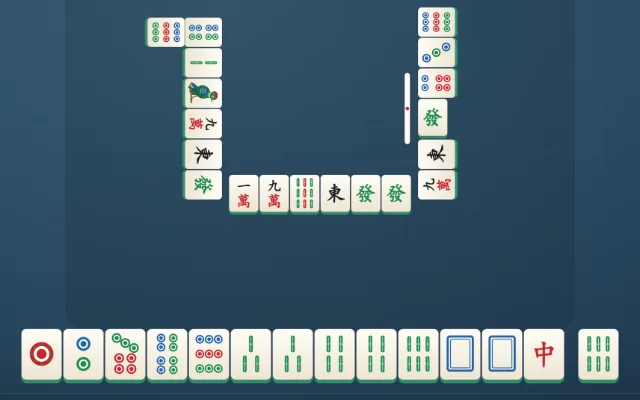
- The area above your hand shows waits and furiten. A complete hand that cannot win displays the reason: no yaku or furiten.
Abortive draw
- Abortive draws transfer no points. The dealer repeats, honba increases by 1, and riichi deposits carry over.
- Nine terminals: on your first draw, if no one has called or pulled North, nine or more distinct terminals/honors let you declare an abortive draw.
- Four kans: four kans shared by multiple players cause a draw if the discard after the fourth kan is not won. Four kans by one player do not cause a draw.
- With three players there is no four-winds, four-riichi or triple-ron abortive draw.
Draws and scoring
- Everyone starts with 35,000. An East round plays East 1–3, and an East–South game adds South 1–3. The game ends early if anyone goes below zero.
- On tsumo only the other two players pay and the missing fourth share is not made up (tsumo loss). On ron the discarder alone pays the same amount as in four-player mahjong.
- Honba: each adds 200 points to a ron, or 100 points from each payer on a tsumo. The winner takes the riichi deposits.
- When the wall runs out, noten players pay a total of 2,000 points to tenpai players. A tenpai dealer repeats.
- Nagashi mangan: if all your discards are terminals/honors and none were called, you collect a mangan tsumo (again from only two players).
- At the end, players are ranked by points: 1st +15, 2nd 0, 3rd −15 (not applied to a single-hand game).
Frequently asked questions
Can another player ron a North you pulled?
Yes. A pulled North is shown on the table, and a player waiting on North with a single or a two-pair wait can ron it (it does not count as robbing a kan). If someone is in riichi and no North has appeared yet, think before pulling it right away. Pulling North also cancels everyone's ippatsu.
Do I need a download or a linked email?
Play directly in your browser without a download. Linking email is an optional way to recover your account. Before clearing browser data, consider whether you need to keep your account or local records.
Do matches earn or spend coins?
Earn coins by checking in and spend them on cosmetics. Matches never cost or award coins.